

Komodor vs. Turbonomic
Beyond cost optimization, only Komodor delivers a Kubernetes-native AI SRE platform that unifies real-time troubleshooting, reliability-aware cost optimization, and autonomous remediation.
Trusted by engineering organizations that need to optimize cost and performance at scale














TL;DR Why Enterprises Choose Komodor over Turbonomic for both Cost & Reliability

Reliability-Aware Cost Optimization
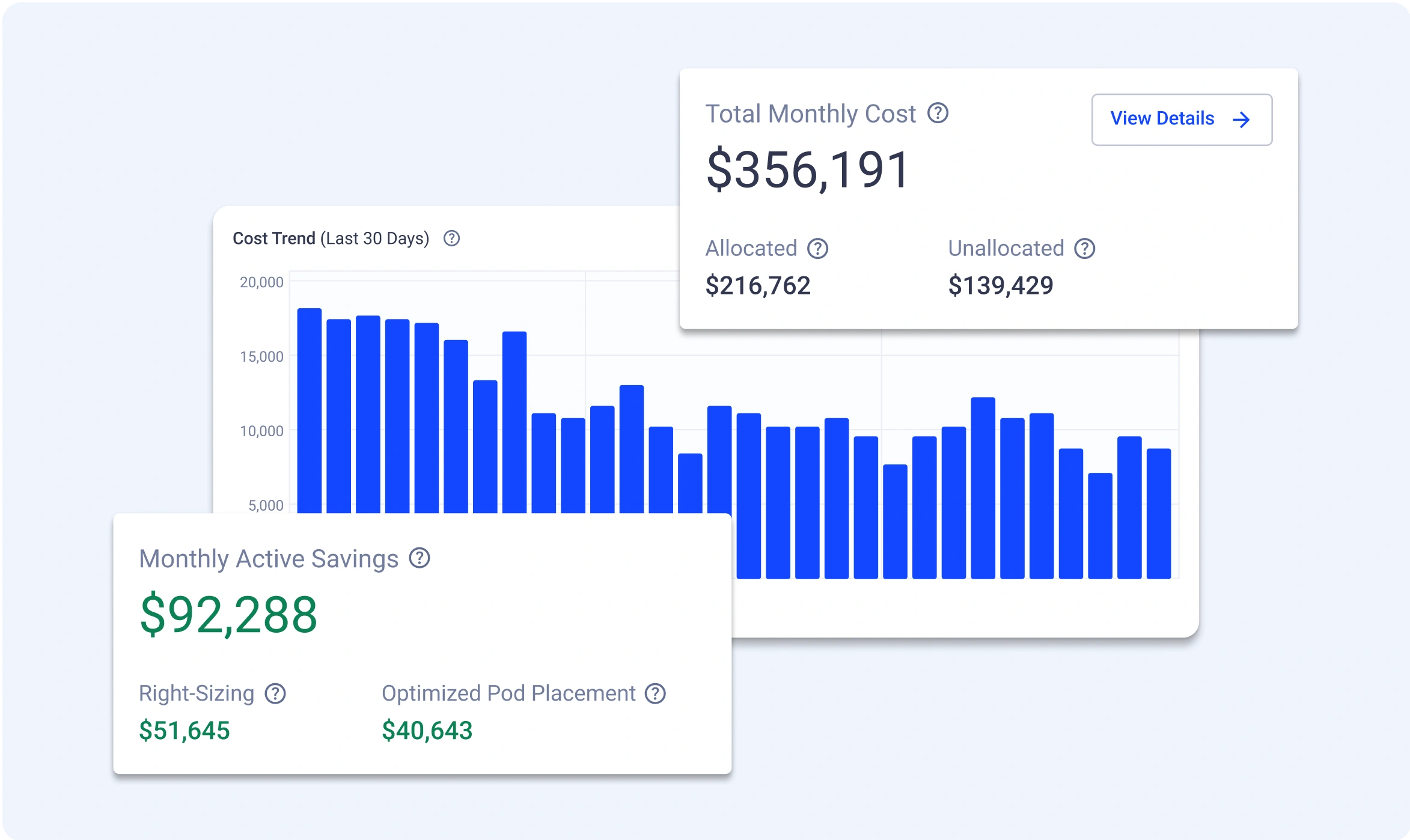
Turbonomic focuses narrowly on savings, which can lead to aggressive resource cuts that cause production incidents. Komodor treats cost as an integral part of system health, validating every rightsizing decision against real-time performance and historical health data.

Actionable AI Troubleshooting
While Turbonomic is primarily a resource management and visibility tool, Komodor is powered by Klaudia, an Agentic AI that provides 95% accurate root cause analysis and guided remediation. This reduces MTTR by over 65% and empowers developers to resolve issues without opening tickets.

Cloud-Native vs. Legacy IT
Turbonomic is a legacy IT tool extended for Kubernetes, often leading to poor recommendations that lack granular context. Komodor is built from the ground up for Kubernetes, providing developers, DevOps, and Platform Engineers with self-service troubleshooting and workflows.
Feature Comparison: Komodor vs. Turbonomic
Frequently Asked Questions
Turbonomic is a complex Application Resource Management (ARM) tool designed for Central IT to manage hybrid cloud resources like VMs and on-prem hardware. Komodor is a specialized, Kubernetes-native AI SRE platform designed for DevOps and Platform teams to master the daily complexities of containerized operations, including troubleshooting, remediation, and cost optimization.
No. Turbonomic is designed for resource allocation and cost optimization. It does not provide automated root cause analysis for application failures, cascading errors, or configuration-related outages, capabilities that are core to the Komodor AI SRE platform.
Optimizing for cost alone is a liability. Aggressive resource reduction can trigger latency spikes or OOMKills if the tool doesn’t understand application behavior. Komodor’s AI correlates every cost-saving action with real-time health signals to ensure optimization never compromises your performance or SLAs.
Komodor can be deployed in minutes and begins delivering value through full-stack visibility and automated RCA immediately. Turbonomic is often a major enterprise implementation project that requires significant top-down configuration and ITIL alignment.
That makes sense for managing your VMs and high-level cloud resources. But for the dynamic, fast-moving world of Kubernetes, you need a specialized, K8s-native tool. Turbonomic’s recommendations for K8s are often too slow or lack the granular context of how modern applications behave. Komodor provides that specialized, real-time control layer that complements your broader IT management.
No. Turbonomic is focused strictly on resource metrics and cost. It does not monitor for Kubernetes-specific configuration drift, nor does it provide the RBAC and Just-in-Time (JIT) access management that platform teams need to secure their clusters. Komodor treats configuration integrity and secure access as core pillars of a healthy, reliable cloud native infrastructure.
Turbonomic uses a deterministic engine centered around resource “supply and demand” to drive its recommendations. Komodor is powered by Klaudia, an Agentic AI SRE. While Turbonomic focuses on the “what” (e.g., “this node is 90% full”), Klaudia investigates the “why” (e.g., “this pod is crash-looping because of a recent ConfigMap change”) and can autonomously execute the multi-step remediation needed to fix it.
Trusted by FinOps Teams Worldwide
See why Dev, Platform u0026 FinOps teams love Komodor on G2











Hundreds of Klaudia Agents for Cost Aware Cloud Native Coverage
Komodor is the only platform that provides a contextual understanding of everything running in your clusters; from workloads and native resources to critical add-ons like service meshes and autoscalers. Battle-tested and purpose-built for demanding large scale enterprise environments, who prioritize cost optimization with reliability.




















The Only AI SRE for Cost Optimization
Powered by Klaudia Agentic AI, Komodor rapidly resolves the resource inefficiencies and performance-killing bottlenecks that inflate your cloud bill. Komodor’s specialized agents autonomously correlate live telemetry with historical data to implement automated workload right-sizing, intelligent bin packing, and eliminate the waste caused by unevictable pods.