

Research Report
2026 Agentic Operations Survey: How 1,000 Engineering Organizations Run AI Agents in Production

Coding agents got the headlines. But when agents write and review code at machine speed, the changes, deploys, tickets, and incidents land on the people who run production. That’s where agents are arriving now: investigating incidents, triaging tickets, automating toil, and increasingly changing production on their own.
Read on their own, the numbers look like a healthy adoption curve: large fleets, real budgets, and operations use cases pulling ahead of coding. Read side by side, they tell a different story. Teams want agents to act, but they don’t yet have the control, the visibility, or the cost picture to let them.
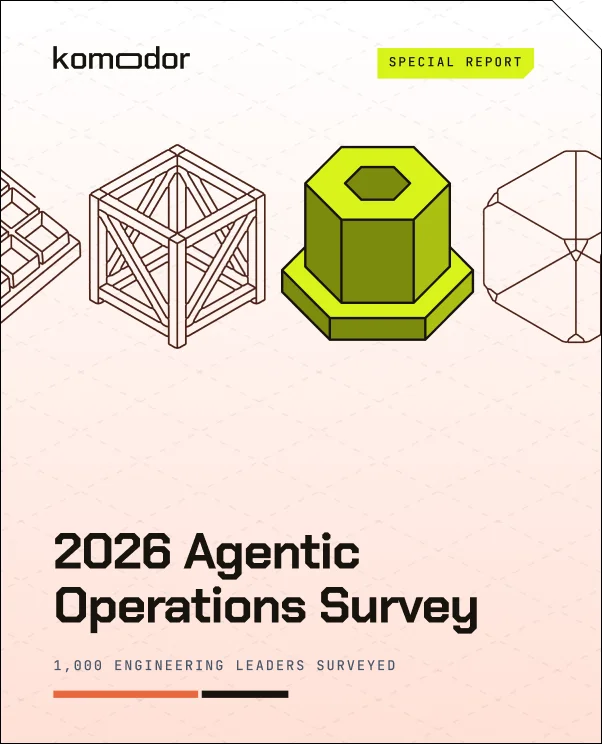
We asked 1,000 engineering, IT, and technology leaders, nearly half of them director-level or above, seven questions about running AI agents in production: how many they run, what they spend, what gets in their way, and how far they let agents act without a person. This report shows every answer and what it means for the teams who run production.
Download the report to find out why:
- 83.9% of organizations run more than ten ops agents, and 27.9% run more than a hundred.
- 1 in 19 leaders can’t say how many agents are running in their organization.
- 68.4% spend $10,000 or more a month on AI agents, and 12% spend $250,000 or more.
- 1 in 4 has no visibility into, budget for, or cap on what their agents cost.
- 53.6% name building safe guardrails a top-three challenge, the most-cited of eight options.
- 75.7% keep a human in the loop for some or all production changes.
What This Report Covers
Each page takes one survey question, shows the full distribution of answers, explains what it means for the people who run production, and closes with a checklist for practitioners. The report ends with a plan for putting the controls where they belong: in the platform, not in each agent.
Some of the practitioner advice inside:
- Count your agents in five minutes, or make that your first project. Register every agent like a service, with a named owner, a scope, a version, and a kill switch, in one place the whole organization can query.
- Treat ten agents like ten new hires. Agents with write access deserve the same access-review cadence, and agent inventory and cost need a named owner at the platform level. In most organizations, nobody has that job yet.
- Build an eval factory before your software factory. Agents don’t hold up to change the way traditional software does, so you need a trustworthy way to evaluate every new version before it’s promoted.
- Tag cost per agent and per run while the fleet is still small. Set budgets and caps at the platform layer, not in each agent’s code, and report cost per resolved task rather than per token.
- Make autonomy a per-action decision, not a per-agent one. Read freely, write to non-critical targets, hold anything risky for approval, and promote an action to autonomous only after it has a clean approval record.
Get your free copy
Ready to go beyond
K8s Management?
Schedule your personalized, 30-minute demo with one of our
K8s experts now.

