
In reliability engineering, being ‘mostly right’ is a liability. An AI SRE that sometimes misses the root cause or gives a confident, wrong answer at 2:17 AM has no place in an enterprise cloud environment. In this context, silence is better than noise.
That’s the bar Klaudia is built to clear: genuine reliability that you can trust in production. The kind of reliability that earns a place alongside your best engineers.
Getting there requires more than just a capable model. In fact, over time, our focus has shifted almost entirely to building and honing the infrastructure to ruthlessly evaluate agentic performance.
Today, our engineers spend roughly 80% of their time on that effort – building and running continuous, multi-layered validation against 100+ complex, real-world, failure scenarios to ensure that Klaudia is boringly, predictably reliable.
A Specialized Architecture, Not a General-Purpose Model
Klaudia isn’t a single AI trying to do everything. It’s an ecosystem of 70+ SME (Subject Matter Expert) agents, each purpose-built for specific SRE disciplines.
Every agent is composed of three layers:
Skills: These are targeted capabilities tuned for specific SRE tasks, from log analysis to deployment triage, or specific domains, from Argo CD to Postgres and more.
Tools and Integrations: Direct hooks into your infrastructure stack, so agents work in your environment rather than around it. Defines which tools the agent has access to, what other agents it can call, and how.
Guardrails: Operational boundaries that prevent agents from taking actions outside their defined scope, keeping human engineers firmly in control.
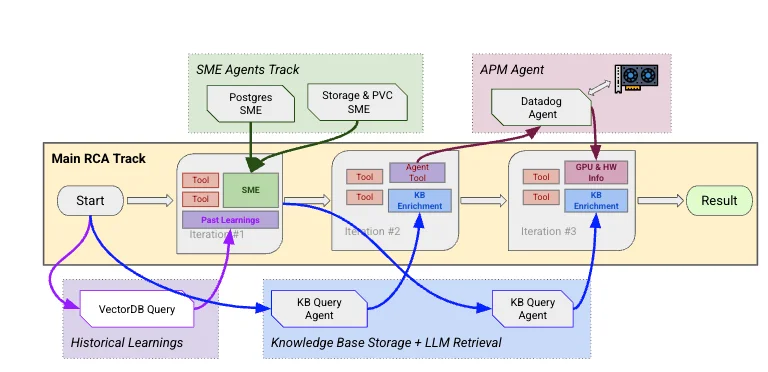
We chose this architecture not just to reproduce the traditional incident war room, but also for isolation. As many have already noted, more data doesn’t result in better outcomes. In fact, the opposite is true – too much data confuses AI agents and increases the probability of hallucinations. Narrowing down the context and scope to a specific domain, however, produces highly skilled and reliable agents that are hyper-focused on expertise in that domain.
But smart architecture and strict guardrails only establish the baseline. In an enterprise environment, “designed to be reliable” isn’t enough. To actually earn the keys to production, every agent is subject to ongoing, rigorous evaluation to prove it meets the standard of a seasoned SRE.
How We Measure What Actually Matters
Most AI benchmarks measure performance against synthetic tests or abstract standards. We measure Klaudia against the one benchmark that matters: how a senior SRE would actually respond. And we, at Komodor, thoroughly understand how SREs think and operate, because our engineers spent years in the trenches maintaining production reliability. That expertise is baked into the product on top of knowledge accumulated from resolving millions of complex incidents for Komodor’s enteprise customers.
We know that trust and predictability are a barrier to entry for enterprises; that’s why we prioritized precision over everything else, and why our engineers spend most of their time and resources on Klaudia’s internal lab. Not on prompting, not on UI, but on making Klaudia reliable and boring enough to be trusted in production.

Below are some of the internal eval mechanisms Klaudia agents must pass before being released in the wild.
The Mirror Test
Our primary evaluation method benchmarks Klaudia’s analysis against the conclusions of experienced SRE engineers given identical data and scenarios. We’re not asking whether the AI sounds confident. Instead, we’re asking whether it reaches the same conclusions a seasoned human would. This is a harder, more meaningful test, and it’s the standard we hold ourselves to.
LLM-as-a-Judge
Every production session is scored by a dedicated “Judge” agent that evaluates responses for accuracy, relevance, and reasoning quality. This creates a continuous feedback loop: performance baselines are tracked over time, and regressions are caught before they reach users. Human engineers step in to tune agents that don’t pass the bar, and run them through the wringer again until they do.
Shadow Agents
Before any new version of Klaudia reaches production, it must first prove itself as a Shadow Agent. In this data-driven release process, the new version runs in parallel with the live system on identical real-world incidents, solving them independently without impacting production. Their outputs are then meticulously graded against the current production baseline by the LLM-as-a-Judge, which scores both agents across several critical dimensions:
- Accuracy
- Reasoning quality
- Evidence grounding
- Actionable precision
- Letancy
- Token efficiency
- Natural language articulation
A new version only ships when it demonstrably outperforms or equals its predecessor based on these objective scores, removing all guesswork from the deployment cycle. This “A/B testing on steroids” mechanism is the primary way we evaluate and validate everything from new foundational models (such as switching from Claude Sonnet 3.5 to 4.5) to prompt refinements and specialized SME agents. By maintaining at least one background A/B experiment at all times, we ensure that every release is a measurable step forward in reliability.

The Golden Standard Library
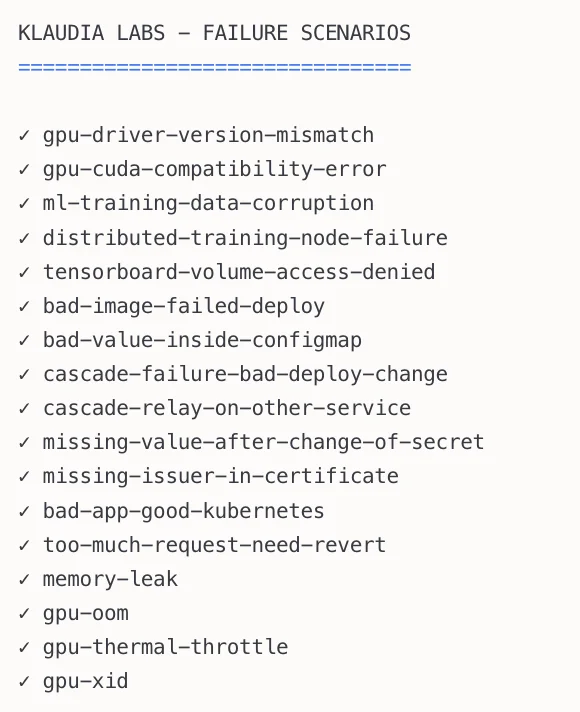
We maintain a curated library of over 100 specific failure scenarios – a mix of synthetic failures and anonymized real-world incidents. This library is the foundation of our regression testing, ensuring that root cause analysis stays sharp across both common failure modes and edge cases as the system evolves. The library doesn’t just contain grueling failure scenarios, but also examples of what the golden standard for RCAs should look like.
Post Session Analysis
The bottom line is always: ‘Did the fix work?’ It doesn’t matter if the UI is sleek, the freeform chat is articulate, or the RCA reasoning is really convincing, if, in the end, the issue isn’t fully resolved. Each RCA session is analysed by human engineers with AI assistance to grade the outcome, the only one that truly matters.

Klaudia Lab: Where Fast Iteration Happens Safely
Good engineering requires the ability to experiment without risk. Klaudia Lab is our internal development environment where our engineers can replay real production sessions locally – rapidly testing new models, skills, prompts, and agentic workflows against real data, deployed on securely contained infrastructure that mirrors real-life enterprise environments.
Since local development is faster, it enables more iterations in a shorter span of time, which results in more seasoned agents who have passed through the fire of production. In this case, speed equals quality: real-world fidelity without real-world risk.
Reliability as a Product Commitment
The infrastructure described here isn’t just a behind-the-scenes detail. Precision at scale doesn’t happen by accident. It’s the output of continuous evaluation, honest benchmarking, and a commitment to shipping only what’s been proven to work.
That’s the standard we’ve set. It’s also the only one worth holding an AI SRE to.
Discover why enterprise platform and SRE teams trust Komodor agentic AI to reduce TicketOps, accelerate incident response, and simplify the management of complex cloud-native environments. Book a demo with one of our AI SRE experts.