
Onboarding new engineers to complex Kubernetes environments is expensive. Junior engineers need to learn cluster architecture, understand organizational conventions, navigate internal documentation, and build relationships with senior team members who can answer questions. The process takes weeks or months, and during that time, senior engineers spend significant time mentoring instead of working on complex problems.
This scenario walks through how AI-augmented knowledge transfer changes the onboarding experience, using a real example from a containers team implementing changes to HiveMQ infrastructure.
The Challenge: Context-Heavy Tasks for New Team Members
A junior engineer receives a task to add pods to the HiveMQ deployment. This is a straightforward infrastructure change in theory, but in practice it requires understanding the existing HiveMQ configuration, navigating internal documentation about deployment standards, researching external documentation for HiveMQ best practices, and coordinating with the engineering lead for review and approval.
For experienced engineers, this task might take an hour. For junior engineers, it becomes a multi-hour exercise in context gathering and validation. The actual configuration change is simple, but understanding whether the change is correct requires knowledge that new team members don’t have yet.
Before AI: The Traditional Mentoring Cycle
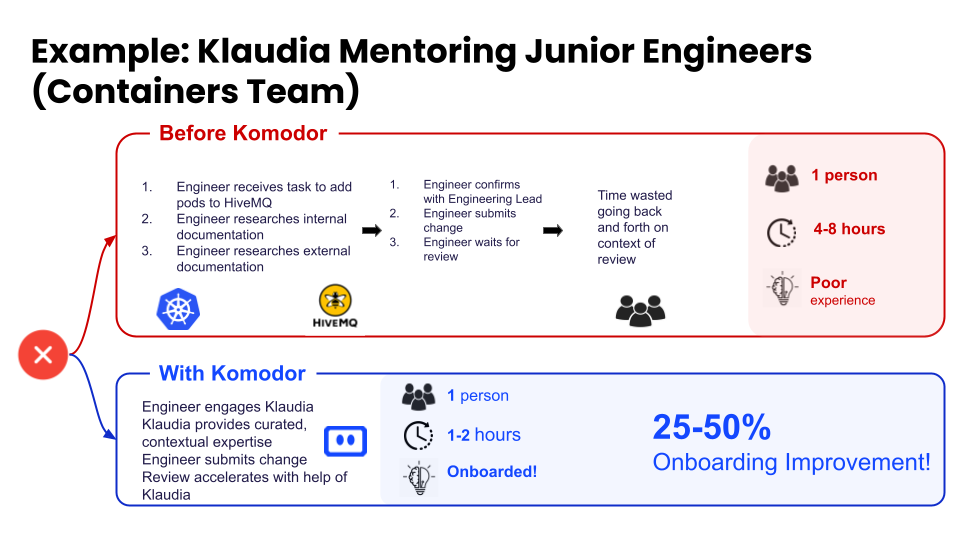
The junior engineer starts by researching internal documentation to understand how the team manages HiveMQ deployments. The documentation exists but isn’t always complete or up-to-date. Some context lives in Slack conversations, some in Confluence pages, some in commit messages from previous changes.
They also research external documentation to understand HiveMQ capacity planning and deployment patterns. The official HiveMQ docs provide general guidance, but applying that guidance to the organization’s specific infrastructure requires additional context about cluster sizing, resource allocation, and service dependencies.
Once they have a general understanding, the engineer needs to confirm their approach with the engineering lead. This creates a dependency on senior engineer availability. If the lead is in meetings or focused on critical work, the junior engineer waits. Even when the lead is available, they need time to context-switch and review the junior engineer’s understanding.
The junior engineer then submits their change for review. The review process becomes another teaching opportunity. The lead provides feedback on aspects the junior engineer missed or didn’t fully understand. This back-and-forth continues until the change meets the team’s standards.
The entire process is valuable for learning, but it’s inefficient for both parties. The junior engineer spends significant time searching for context and waiting for validation. The senior engineer spends time context-switching to answer questions and review work that experienced team members would complete independently.
Result: 1 person, 4-8 hours to complete the task, poor experience due to context gaps and waiting for senior engineer availability.
The task eventually gets done, but the time investment is high and the learning experience is fragmented across multiple context-gathering activities.
With AI SRE: Curated Contextual Expertise on Demand
The same junior engineer receives the task to add pods to HiveMQ. Instead of starting with scattered documentation searches, they engage Klaudia to understand the task requirements and organizational context.
Klaudia provides curated, contextual expertise immediately. It understands the organization’s HiveMQ deployment patterns, knows the standard procedures for capacity changes, and can explain both the technical steps and the reasoning behind them. The AI draws on the accumulated knowledge from previous similar changes across the organization.
The junior engineer asks Klaudia about capacity planning considerations for HiveMQ. The AI provides specific guidance based on the organization’s actual usage patterns, not generic best practices from external documentation. It explains how to calculate the appropriate pod count based on message throughput, connection patterns, and redundancy requirements.
When the engineer has questions about deployment standards, Klaudia provides the relevant internal conventions without requiring the engineer to search through multiple documentation sources. When they need to understand HiveMQ configuration options, the AI explains them in the context of how the organization actually uses HiveMQ.
The engineer submits their change with confidence because Klaudia has already validated their approach against organizational standards. The review process with the engineering lead accelerates because the AI has already caught common issues and ensured the change follows established patterns.
The lead’s review focuses on higher-level architectural considerations rather than basic correctness. They can provide more valuable feedback because they’re not spending time on fundamental issues the AI already addressed.
Result: 1 person, 1-2 hours to complete the task, 25-50% improvement in onboarding experience.
The task gets done faster, but more importantly, the junior engineer learns the right context and patterns from the start rather than piecing together understanding from fragmented sources.
Why Traditional Onboarding Is Inefficient
Engineer onboarding follows an apprenticeship model that doesn’t scale well. Junior engineers learn by asking questions, making mistakes, and getting feedback from senior team members. Each question requires senior engineer attention. Each mistake creates rework. The knowledge transfer happens gradually through repeated interactions.
This creates a productivity problem for both junior and senior engineers. Junior engineers spend time searching for context that senior engineers could provide in seconds if they were available. Senior engineers spend time answering questions they’ve answered dozens of times before and reviewing work that could be correct from the start with better guidance.
The documentation problem makes this worse. Organizations create internal documentation to capture knowledge, but documentation goes stale, doesn’t cover every scenario, and often assumes context that new engineers don’t have. External documentation provides general guidance but doesn’t reflect organizational conventions or infrastructure specifics.
As teams grow and need to onboard more engineers, the mentoring burden on senior engineers increases. Each new team member requires similar time investment. The cost scales linearly with team size, which limits how quickly organizations can expand their engineering capacity.
The On-Demand Mentoring Advantage
Human mentoring requires coordination and creates dependencies. Junior engineers must wait for senior engineer availability. Senior engineers must context-switch from their current work to provide guidance. The timing rarely aligns perfectly, which creates delays.
AI mentoring is available immediately without requiring coordination. Junior engineers get answers when they need them, not when senior engineers happen to be available. The guidance is consistent regardless of who’s asking or when they’re asking. The AI doesn’t get frustrated by repeated questions or forget to mention important context.
This doesn’t replace human mentoring entirely. Senior engineers still provide valuable architectural guidance, code review, and career development. But AI handles the routine knowledge transfer that previously consumed senior engineer time. This frees senior engineers to focus on higher-value mentoring activities.
While this scenario focuses on adding pods to HiveMQ, the same knowledge transfer pattern applies to any context-heavy task that new engineers encounter. Understanding how the organization structures Kubernetes namespaces. Learning the CI/CD pipeline configuration standards. Navigating the service mesh setup. Implementing observability for new services.
All of these require understanding organizational conventions that aren’t fully documented. All of them benefit from contextual guidance that’s specific to how the organization operates rather than generic best practices. All of them traditionally require senior engineer time to explain and validate.
AI trained on organizational telemetry handles these variations because it’s learned the underlying patterns and conventions from observing how experienced engineers work. It can provide contextual guidance across different types of tasks because it understands what makes solutions appropriate for the specific organization.
Changing the Onboarding Game for Engineering Teams
The productivity gain for individual tasks is significant: reducing 4-8 hour onboarding tasks to 1-2 hours. But the cumulative effect across a team’s onboarding process is more substantial.
When new engineers can complete tasks faster with less senior engineer involvement, teams can onboard more people simultaneously without overwhelming their senior engineers. The limiting factor shifts from mentoring capacity to hiring pipeline. Organizations can scale engineering teams more aggressively.
The onboarding experience improves for junior engineers. They spend less time feeling stuck or waiting for answers. They learn organizational conventions faster because the AI provides consistent guidance from day one. They build confidence more quickly because they get immediate validation that their approach is correct.
For senior engineers, the mentoring relationship becomes more rewarding. Instead of answering basic questions about internal procedures, they focus on teaching complex problem-solving skills, architectural thinking, and strategic decision-making. The time they spend mentoring produces more value for both parties.
The Junior On-Ramp to Engineering
There’s a narrative circulating that AI will replace junior engineers, creating a problematic gap where no one gets trained to become the next generation of senior engineers. The reality tools like Komodor are making possible, is quite the opposite. AI augmentation makes junior engineer positions more lucrative, not obsolete. Organizations that successfully adopt AI aren’t eliminating entry-level roles, they’re making those roles more productive from day one.
The barrier to entry for junior engineers has always been the knowledge gap between academic training and production systems. AI doesn’t eliminate the need for junior engineers, it provides the on-ramp that makes that transition manageable. Instead of spending months struggling to understand organizational context before becoming productive, junior engineers contribute meaningfully within weeks while building the expertise that will make them effective senior engineers.
The 25-50% improvement in onboarding isn’t just about completing individual tasks faster. It’s about the cumulative effect of faster task completion, less time waiting for senior engineer availability, fewer mistakes that require rework, and more consistent learning of organizational patterns.
Elite engineering teams measure onboarding success by how quickly new engineers become productive contributors. With AI-augmented knowledge transfer, that timeline compresses significantly. Junior engineers complete their first substantial projects faster, require less senior engineer oversight sooner, and absorb organizational conventions more quickly.
AI-augmented knowledge transfer frees senior engineers up to focus on complex guidance that actually requires human expertise.
This was part seven of an ongoing series on AI SRE in actual production practice. If you missed the previous parts, you can find them here:
- AI SRE in Practice: Part One; What Real AI SRE Can Actually Do When Production Breaks
- AI SRE in Practice: Part Two; Resolving GPU Hardware Failures in Seconds
- AI SRE in Practice: Part Three; Diagnosing Configuration Drift in Deployment Failures
- AI SRE in Practice: Part Four; Resolving Node Termination events at scale
- AI SRE in Practice: Part Five; Tracing Policy Changes to Widespread Pod Failures
- AI SRE in Practice: Part Six; Diagnosing AWS CNI IP Exhaustion Before Widespread Outage