

Platform Engineering leaders are caught between two competing imperatives. You’re under pressure to flatten cloud spend but your team is still provisioning defensively because nobody wants to be the person who causes a production incident. You try to optimize, but six months later, when someone pulls a report, nothing has changed.
Industry estimates consistently put cloud waste at 30 to 35 percent of total spend – budget that gets pulled directly from the planned hiring and infrastructure investments that determine whether your systems stay reliable.
The old playbook for dealing with cloud waste – tagging policies, manual rightsizing exercises, quarterly reviews, was already struggling before containerized, dynamic infrastructure became the norm. Now it’s become impossible to keep up by hand. Workloads shift, usage patterns drift, autoscalers do things nobody asked them to do, and the spreadsheet in the FinOps team’s shared drive is always three weeks behind reality.
Increasingly, AI is becoming seen as the answer to this gap, the thing that makes continuous, intelligent, and contextual optimization actually tractable at scale. Here’s how AI is actually being deployed for FinOps in practice, and the risks you need to be aware of to ensure your SLAs are not put at risk.
What AI is actually doing in cloud-native cost optimization
Autonomous Rightsizing
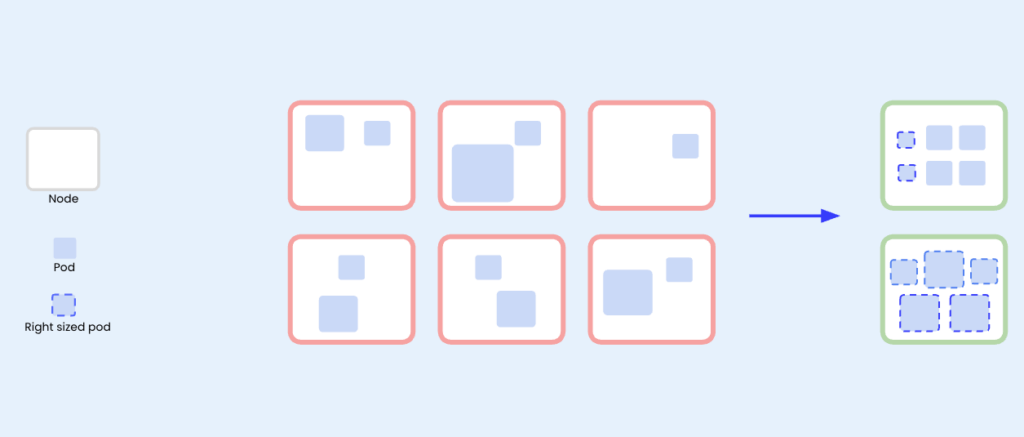
Workload rightsizing is probably the most mature use case and application of AI. The way it works is that AI analyzes real-time and historical CPU and memory utilization to determine the actual envelope a workload needs, not the envelope someone estimated when they provisioned it 18 months ago.
Rightsizing works when it’s treated as an ongoing process rather than a project you complete – like all engineering domains. Usage patterns shift, and a recommendation that was accurate six months ago may not reflect what the workload is doing today. An AI optimizing purely on utilization data, without understanding why a resource is provisioned the way it is, will make recommendations that trade a FinOps win for an SRE incident.
Predictive Autoscaling
Predictive autoscaling takes a different angle; rather than reacting to traffic spikes after they hit, ML models anticipate demand and scale before it arrives. This reduces both over-provisioning (the kind that shows up on your bill) and under-provisioning (the kind that shows up in your latency graphs and your Slack). A holistic approach is key. AI that doesn’t take into account existing autoscalers (HPA, VPA, Cluster Autoscaler, Karpenter, Keda, etc.) cannot offer accurate predictions or scale safely and efficiently.
Purchasing Model & Instance Optimization
Instance type and purchasing model optimization has the potential to save the most money but also requires the most nuance. Matching the right workload to Spot/Preemptible Instances and Reserved Instances can offer considerable savings over on-demand. But matching workloads to the right instance types at scale is difficult to do manually because you’re modeling a commitment/flexibility tradeoff across a constantly shifting portfolio of workloads. AI can do this well by recommending coverage levels based on stable workload patterns, or flagging where you’re paying on-demand prices for something that’s been running predictably for six months. What it can’t do automatically is understand the business context behind why something runs the way it does.
Environment Scheduling & Cost Anomaly Detection
Anomaly detection and cost spike alerts are often the first AI use case teams actually adopt, and there’s a reason for that. The risk/reward ratio is high.
You’re not acting on anything, you’re just surfacing unexpected spend patterns before they turn into budget surprises. It’s low blast radius and high value, and it builds trust in the tooling before teams are willing to let it do anything more autonomous.
Examples include idle and zombie resource detection, unused load balancers, unattached volumes, orphaned snapshots, and stopped instances still accumulating cost. All of this is tedious to do manually because it requires continuous scanning and contextual judgment about what “idle” actually means for a given resource, and AI is accelerating this considerably.
Scheduling and time-based optimization is simpler in concept but smarter in practice with AI behind it. Scaling down or shutting off non-production environments during off-hours sounds obvious, but getting it right means learning actual usage patterns rather than applying a blanket policy that turns off an environment while someone’s running an overnight test.
Storage and Egress Optimization
Storage and data transfer optimization rounds things out, recommending storage tier downgrades, identifying unnecessary cross-region transfer, and finding CDN and egress costs that are larger than they need to be.
These use cases are already delivering real value in production environments, and the savings at scale are significant. But cost optimization that runs without the right guardrails has a way of creating problems that are more expensive than the waste it was meant to eliminate.
How AI Cost Optimization Can Go Wrong
One thing becoming increasingly clear about AI-driven cost optimization is that while it’s really good at optimizing at a scale and speed we can’t match by hand, its ability to do so without harming reliability is entirely dependent on the context it’s given.
The most common failure mode is optimization without a reliability context. A database sitting at 15% CPU utilization looks like a candidate for rightsizing. An AI recommendation engine without application-layer awareness will flag it. What it won’t know is that the database is intentionally overprovisioned for burst capacity and that cutting its resources will cause latency spikes on a path that’s directly customer-facing. Acting on the recommendation blindly means you saved money and created an incident, and nobody wins. Over-aggressive autoscaling leaves you with infrastructure that can’t absorb unexpected traffic, and the cost of the resulting incident typically dwarfs whatever was saved on idle capacity.
Spot instance interruption without proper fallbacks is a specific version of the same problem. Moving workloads to Spot instances is a legitimate cost strategy that works well for interruption-tolerant jobs. What it requires is proper interruption handling, checkpointing, and fallback logic, and when those aren’t in place, you get both the cost failure and the reliability failure simultaneously.
As optimization moves from recommending to acting, the blast radius of a bad decision grows. A single misconfigured autonomous policy can cascade, which means human-in-the-loop controls and rollback capabilities aren’t nice-to-haves either, once you’re operating at that level.
What good AI Cost Optimization actually looks like
AI-driven cost optimization done right combines cost signals with health and performance context, where utilization data alone isn’t enough. It must know whether the workload is healthy, what its failure modes are, and – critically – what reliability SLAs it’s sitting under before you act on a cost recommendation.
The same applies to the visibility scope. Kubernetes-level optimization without cloud billing context, or billing-level visibility without insight into what’s actually running on the cluster, means you’re working from a partial picture and optimizing the parts you can see while waste accumulates in the parts you can’t.
The control model matters too, and it needs to match the risk profile of the action. Autonomous execution makes sense for low-stakes, high-frequency optimizations. For changes that touch production workloads, human approval isn’t a bottleneck; it’s a guardrail, and the tooling needs to support both modes rather than forcing a choice between them. Audit trails and rollback capabilities follow the same logic, not as implementation details, but the foundation of whether the system is trustworthy enough to operate at the scope where it delivers meaningful value.
AI has a real role to play in closing the cloud cost gap, and the use cases are mature enough that teams are seeing meaningful results in production.
The organizations treating cost optimization as a reliability-aware practice from the start are the ones playing the right game, because the stakes in FinOps aren’t just budget as many major outages have taught us. Because when it comes to your production systems, penny wise and pound foolish has a way of impacting your uptime before it impacts your bottom dollar.
Reliability-First Cloud-Native Cost Optimization with Komodor
Discover why Komodor – powered by Klaudia Autonomous AI SRE – is trusted by enterprise engineering leaders to manage, troubleshoot and optimize complex cloud-native environments. Explore the platform to see how Komodor correlates cost-saving opportunities with real-time health signals to safely optimize Kubernetes at scale.