
Gartner predicts that AI agents will be implemented in 60% of all IT operations tools by 2028, up from fewer than 5% at the end of 2024. This acceleration has sparked an explosion of AI SRE solutions, from enterprise platforms to open-source alternatives, all promising faster root cause analysis and reduced MTTR.
Komodor’s RCA accuracy is maintained above 95% through constant validation and testing. When a new, competing open-source Kubernetes troubleshooting agent was launched, we thought it would be a good idea to put both tools through identical real-world failure scenarios our customers typically encounter. The objective was to benchmark Klaudia Agentic AI and the open-source AI agent, and compare their performance across common Kubernetes failure scenarios.
The Test Setup
Both Klaudia AI and the open source AI agent were deployed on the same standard Kubernetes cluster. Three common failure scenarios served as the test cases:
- Cascading Failure: A server misconfiguration triggers a chain reaction, causing its client service to fail.
- Memory Limits: A pod repeatedly crashes after exceeding configured memory limits (OOMKilled)
- Invalid YAML: A pod enters CrashLoopBackOff due to a syntax error in its ConfigMap
Each scenario represents failures that infrastructure teams encounter regularly, with issues where speed and accuracy in diagnosis directly impact performance. So let’s see the two AI SREs in action and zoom in on what Kubernetes troubleshooting in enterprise-scale production environments really demands.
Scenario 1: Cascading Services
A client deployment was unable to connect to its corresponding server component. This resulted in the client’s health checks failing and the overall deployment entering an unhealthy state due to connection refused errors. The server component itself was also experiencing issues, preventing it from responding to the client.
OSS AI Agent’s Analysis
The open source AI Agent identified the connection failure between the client and the server. It gathered data using 8 tools but provided minimal analysis in its output.
The summary pointed to the symptom of “connection refused” without drilling into why the server was actually failing.
Klaudia Agentic AI Analysis
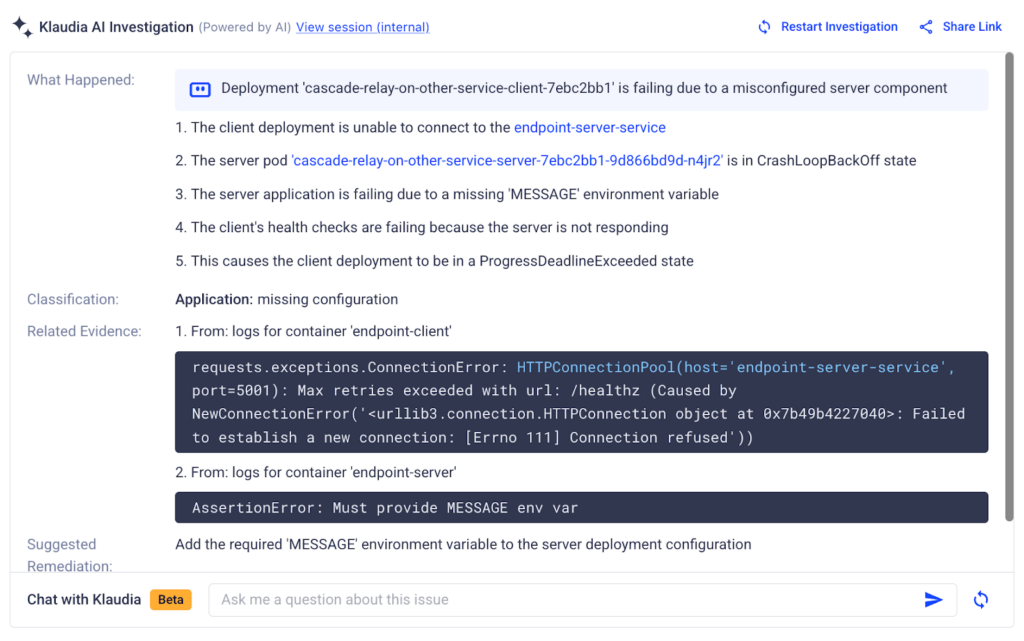
Klaudia identified the root cause explicitly as “The server application is failing due to a missing ‘MESSAGE’ environment variable.”
The analysis provided a numbered breakdown showing the failure cascade (client connection attempts → server pod CrashLoopBackOff → missing environment variable → client ProgressDeadlineExceeded), direct evidence from container logs (AssertionError: Must provide MESSAGE env var), and specific remediation steps to add the required ‘MESSAGE’ environment variable to the server deployment.
Key Difference
Klaudia traced the issue to its source as a configuration error, while the open source tool stopped at the connection failure. For an engineer responding to an incident, knowing what failed matters less than knowing why it failed and how to fix it.
Scenario 2: Out-of-Memory
This test simulated an application within Kubernetes that was consuming an excessive amount of memory. The goal was to see how each AI SRE tool would diagnose and report on a situation where a pod’s memory usage approached and ultimately exceeded its configured limits, leading to Out Of Memory (OOM) killed events and pod restarts (CrashLoopBackOff).
OSS AI Agent’s Analysis
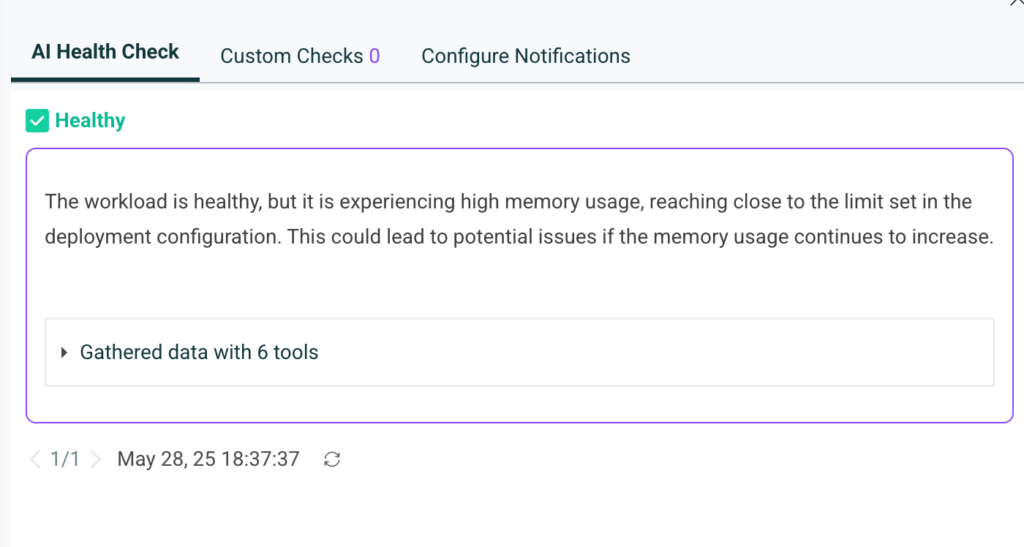
The open source agent reported the workload as “Healthy” with a warning about high memory usage. It mentioned gathering data but didn’t surface the actual OOMKilled events in its summary, effectively downplaying a critical failure.
Klaudia Agentic AI Analysis
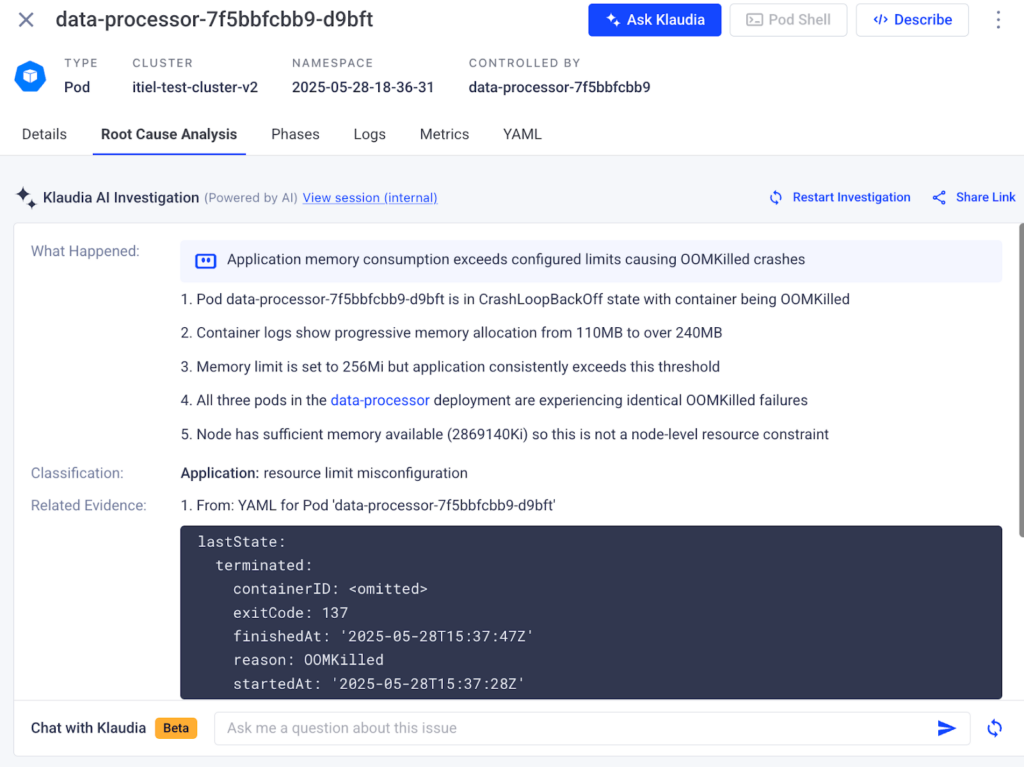
Komodor correctly identified the failure state as “Application memory consumption exceeds configured limits, causing OOMKilled crashes” with pods in CrashLoopBackOff.
The analysis included a step-by-step breakdown of memory growth exceeding the limit, confirmation that multiple pods were affected, evidence directly from pod YAML showing reason: OOMKilled and exitCode: 137, and verification that node-level resources weren’t the issue (which correctly focused the investigation).
Key Difference
Misidentifying an OOMKilled pod as “Healthy” is a fundamental accuracy problem. In a real incident, this would send engineers down the wrong path or cause them to ignore a critical issue entirely.
Scenario 3: Failed Change (Invalid YAML)
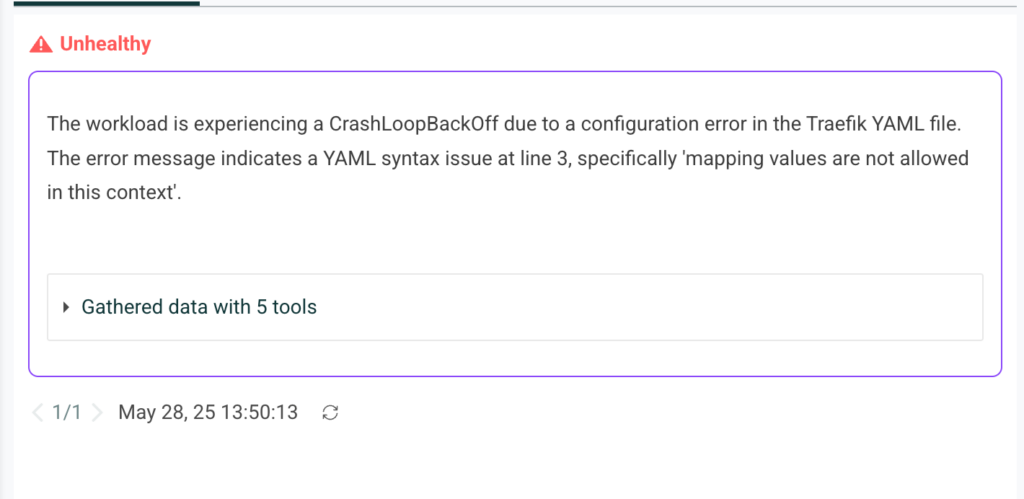
This test involved introducing an invalid YAML configuration into a Kubernetes environment, specifically within a ConfigMap used by a Traefik pod. The objective was to see how effectively each AI tool could diagnose a CrashLoopBackOff state caused by a syntax error in a configuration file, identifying the specific error and its location.
Analysis by the Open Source AI SRE
The OSS agent identified the CrashLoopBackOff and the YAML error message “mapping values are not allowed in this context.” It mentioned a “Traefik YAML file” but didn’t specify which Kubernetes resource contained the error.
Klaudia Agentic AI Analysis
Both tools caught the error, but Komodor provided context that makes remediation faster through explicit resource identification (ConfigMap bad-value-inside-configmap-a13a1ba7), the error log message along with a snippet of the actual malformed YAML, targeted remediation (“Correct the YAML formatting in the ‘traefik.yaml’ key of the ConfigMap ‘bad-value-inside-configmap-a13a1ba7′”), and a clear causal chain (Pod crash → Log error → ConfigMap inspection → Conclusion).
Key Difference
Showing engineers the problematic YAML and telling them exactly which resource to fix eliminates guesswork. Generic error messages require additional investigation, while specific evidence enables immediate action.
What These Results Reveal About AI SRE Tools
The differences between these tools reflect fundamental choices in how agentic AI approaches investigation rather than just cosmetic variations.
Depth of analysis matters more than data collection. The open-source AI SRE agent gathered substantial data across scenarios but struggled to synthesize it into actionable conclusions. Collecting 8 data points means nothing if the summary misses the root cause or misidentifies the severity.
Evidence presentation determines trust.
Komodor’s Klaudia powered approach of showing actual log excerpts, YAML snippets, and exit codes gives engineers confidence in the diagnosis. When you can see the exitCode: 137 or the AssertionError directly, you trust the conclusion. Without that evidence, you really just need to take the AI’s word for it – and that’s a gamble with production systems.
Precision in remediation reduces MTTR. As a concrete example: “Fix the memory limit” is less useful than “Memory consumption exceeded the 256Mi limit, so consider increasing to 512Mi or implementing memory profiling.” The more specific the guidance, the faster the fix.
These scenarios also highlight a broader challenge around trust in AI-driven systems, which comes from consistent accuracy rather than occasional success. A tool that correctly identifies two failures but misses a third, or worse reports a failing workload as healthy, erodes the confidence teams need to act on AI recommendations without manual verification.
Beyond Single-Agent Investigation
This comparison focused on root cause analysis, but production SRE work extends far beyond incident investigation. Komodor’s platform includes autonomous agents for cost optimization, GPU resource insights, a single pane of glass for visualization, access control, and broader cloud-native infrastructure rather than just Kubernetes. The open source AI SRE agent, as a single-agent tool, operates in a far more limited scope.
The cost optimization capabilities are particularly relevant. Finding root causes faster only matters if the infrastructure is also being managed efficiently. Komodor’s AI agents work 24/7 to identify optimization opportunities that compound over time, including idle resources, node density, and inefficient node scaling policies.
The OSS AI Agent represents a meaningful contribution to the open-source Kubernetes troubleshooting ecosystem. It’s worth noting that this tool serves a different audience than enterprise platforms. For teams working primarily with standard Kubernetes configurations, exploring AI-driven troubleshooting for the first time, or operating in resource-constrained environments where an open-source tool is the only viable option, this can provide basic automated investigation capabilities. The tool’s ability to gather data from multiple sources and identify surface-level issues makes it a reasonable starting point for small organizations evaluating whether AI-assisted troubleshooting fits their workflow.
Evaluating AI SRE Tools for Your Environment
If you’re considering AI-powered SRE tools, these test scenarios suggest several evaluation criteria worth considering.
- Run identical failure scenarios across tools, since generic demos don’t reveal where tools struggle. Your actual failure patterns such as OOMKilled pods, cascading failures, and configuration errors are the real test.
- Examine evidence quality rather than just conclusions.
- Does the tool show you why it reached a conclusion? Can you verify its reasoning independently?
- Test accuracy under ambiguity, since the easy cases aren’t the problem, such as how the tool performs when symptoms overlap or when multiple issues occur simultaneously.
- Consider the full operational scope, because if you’re adopting AI for SRE, investigation is only one component. K8s cost management, access control, and broader infrastructure visibility determine whether AI actually reduces operational burden or just shifts it.
Komodor continues evaluating both its own tools and alternatives because the market is moving fast. Maintaining 95%+ RCA accuracy requires constant validation against new failure patterns, infrastructure changes, and evolving Kubernetes features. These comparisons are about understanding where AI-driven investigation delivers real value versus where it introduces new risks rather than declaring winners. We have also recently published a short AI SRE benchmarking guide.
The goal for AI SRE platforms is to build systems that infrastructure teams can actually trust when systems fail at half past midnight, rather than pursuing perfect AI.
About Komodor
Komodor reduces the cost and complexity of managing large-scale Kubernetes environments by automating day-to-day operations. As well as health and cost optimization. The Komodor Platform proactively identifies risks that can impact application availability, reliability and performance, while providing AI-assisted root-cause analysis, troubleshooting and automated remediation playbooks. Fortune 500 companies in a wide range of industries including financial services, retail and more. Rely on Komodor to empower developers, reduce TicketOps, and harness the full power of Kubernetes to accelerate their business. The company has received $67M in funding from Accel, Felicis, NFX Capital, OldSlip Group, Pitango First, Tiger Global, and Vine Ventures. For more information visit Komodor website, join the Komodor Kommunity, and follow us on LinkedIn and X.
To request a demo, visit the Contact Sales page.
Media Contact:
Marc Gendron
Marc Gendron PR for Komodor
[email protected]
617-877-7480